Do your muscles feel constantly tight or weak? What Muscle Testing & P-DTR Can Reveal
Jennifer Tave
Athletes are often told that pain or poor performance comes down to one simple issue: a muscle is either tight or weak. The typical solution follows — stretch what feels tight and strengthen what feels weak.
Yet many athletes find that despite doing everything “right,” the same problems keep returning.
That’s because many “weak” muscles aren’t truly weak, and “tight” muscles are in fact guarding or compensating. These muscles are often what we call “neurologically inhibited” or “hypertonic”. And this is where Muscle Testing and P-DTR offer deeper insight.
Muscle weakness vs. Neurological Inhibition
A truly weak muscle lacks strength due to deconditioning, overload, or insufficient training stimulus. In those cases, progressive strengthening works.
But neurological inhibition is different.
In inhibition:
The muscle is structurally capable.
The nervous system is not fully recruiting it.
Timing and coordination are disrupted.
This altered communication often stems from:
Joint dysfunction
Old injuries
Chronic inflammation
Repetitive stress
Sensory receptor overload
Emotional or physiological stress
When one muscle is inhibited, another must compensate. Over time, certain muscles become chronically tight and overactive while others consistently test “weak.”
The tight muscle isn’t the problem — it’s the body’s survival strategy.
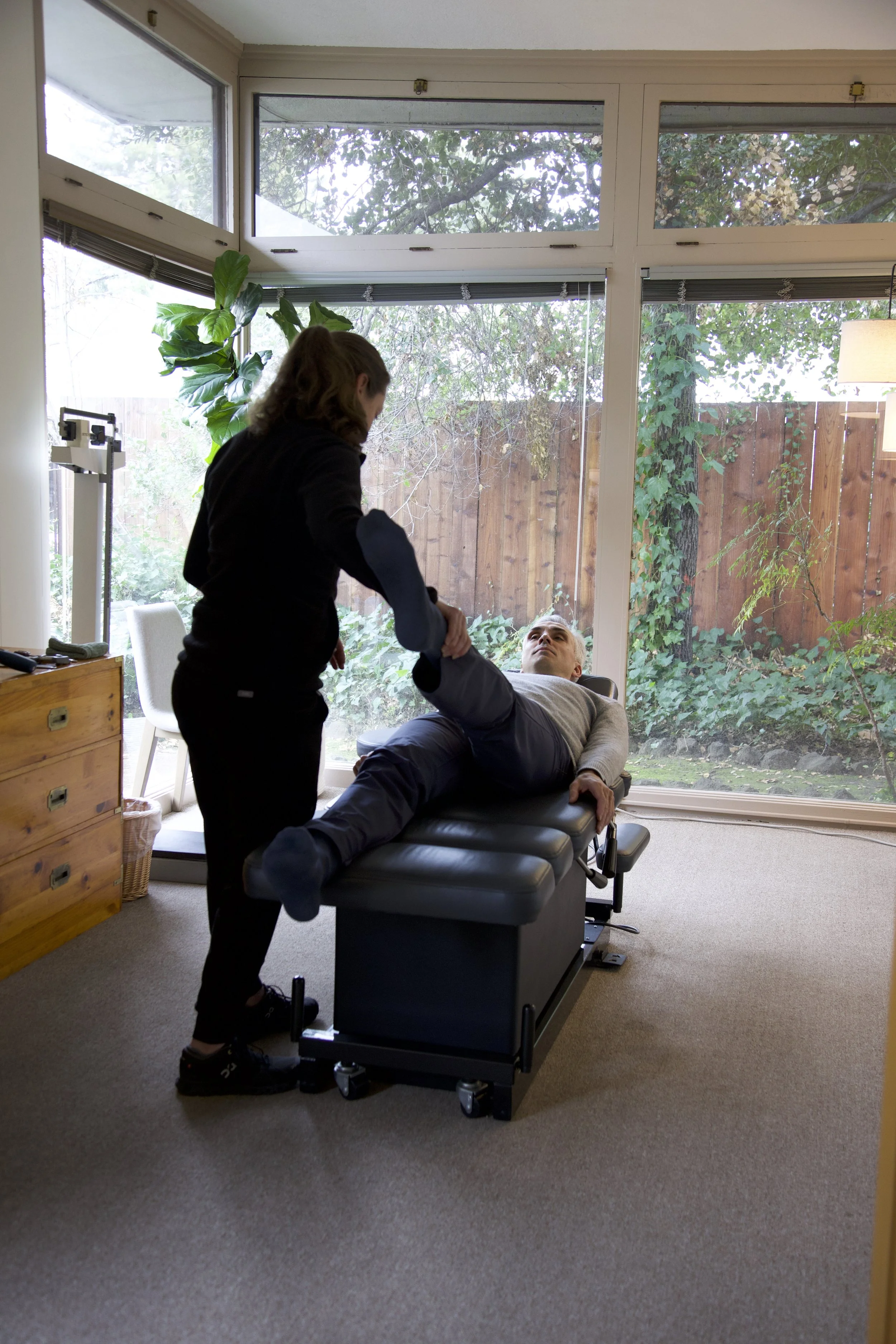
Muscle Testing Hip Flexor Muscles
Neurological Muscle Testing vs. Traditional Strength Testing
Traditional strength testing measures force production. How much can you lift? How much resistance can you overcome?
Neurological muscle testing evaluates something more subtle:
how the nervous system organizes muscle activation under specific conditions.
During this type of testing, I assess:
Consistency of muscle response
Stability under challenge
Changes in muscle firing when joints or sensory input are altered
Where P-DTR Adds Another Layer
With neurological muscle testing, we assess functional weakness patterns. P-DTR (Proprioceptive-Deep Tendon Reflex technique) focuses even more specifically on the sensory input driving those patterns.
Developed by Dr. Jose Palomar, P-DTR is based on the understanding that:
Muscle firing patterns are heavily influenced by sensory receptors.
These include:
Muscle spindles
Golgi tendon organs
Joint mechanoreceptors
Cutaneous (skin) receptors
Ligament and fascial receptors
If these receptors send distorted or exaggerated signals to the brain — often due to injury or repetitive strain — the brain adapts by altering muscle output.
The result?
Inconsistent muscle firing
Delayed activation
Overactive compensatory muscles
Persistent asymmetries
P-DTR assessment challenges specific receptors and observes how muscle response changes in real time. This helps identify which sensory input is distorting the motor output.
Rather than simply strengthening a muscle, P-DTR works to normalize the faulty sensory loop so that the brain can restore appropriate muscle activation.
Why Stretching & Strengthening Alone Often Fail
Consider this common pattern:
Glutes test weak.
Hip flexors feel tight.
Core feels unstable.
Typical response:
Strengthen glutes.
Stretch hip flexors.
Add core exercises.
Temporary improvement happens — but the imbalance returns.
Why?
Because if joint or tendon receptors are sending distorted signals, the nervous system will continue to inhibit certain muscles and over-recruit others. Strengthening an inhibited muscle without correcting the underlying sensory distortion often reinforces compensation rather than resolving it.
The body always prioritizes stability over performance.
Until the nervous system feels safe and organized, it won’t fully activate certain muscles — no matter how many exercises you do.
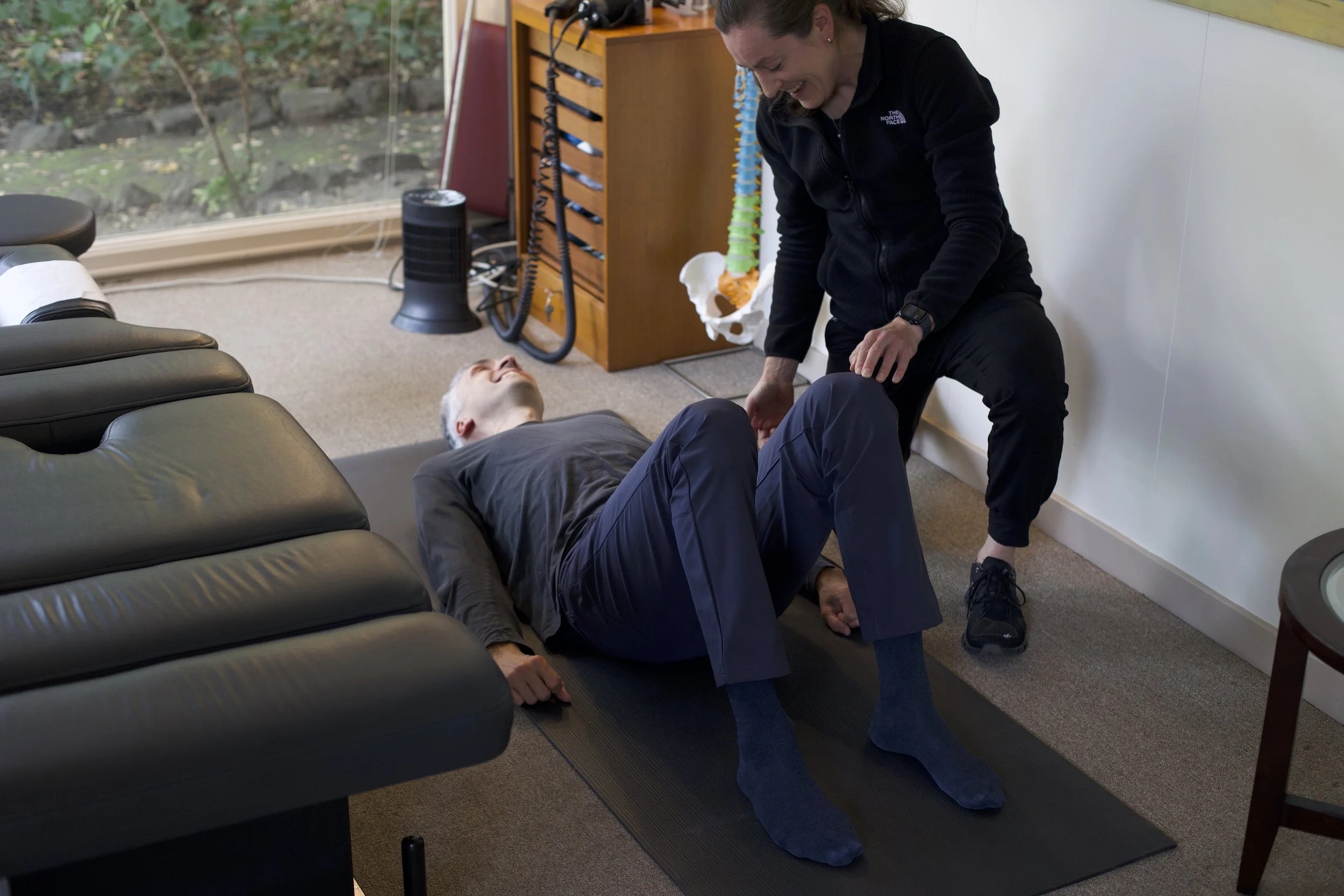
Using targeted strength exercises to help restore proper movement patterns after neurological repatterning
Neurological Inhibition in Athletes
For endurance athletes, repetitive motion amplifies small dysfunctions.
Thousands of pedal strokes or strides per session can magnify:
Pelvic imbalances
Subtle joint restrictions
Altered firing timing
Asymmetrical loading
Over time this leads to:
Chronic “tight” hamstrings
Recurring hip flexor strain
IT band irritation
Shoulder or neck tension
Power plateaus
When neurological inhibition is addressed, athletes often notice:
Improved coordination
More balanced muscle engagement
Reduced compensatory tightness
Increased efficiency and smoother movement
Not because muscles suddenly became stronger — but because they’re finally firing correctly.
LOOKING AT THE BIGGER PICTURE
Muscles don’t function in isolation. They are the output of a complex sensory-motor system.
Muscle testing helps identify where muscle function is disrupted.
P-DTR helps determine which sensory inputs are driving that disruption.
Together, they provide a more complete picture of why imbalanced muscle firing patterns develop — and why they persist.
If you feel like you are constantly managing tightness, weakness, or recurring injury, the real question may not be: “How strong are my muscles?”
But rather:
“Is my nervous system allowing this muscle to fire correctly?”
When firing patterns normalize, strength, stability, and performance often follow naturally.